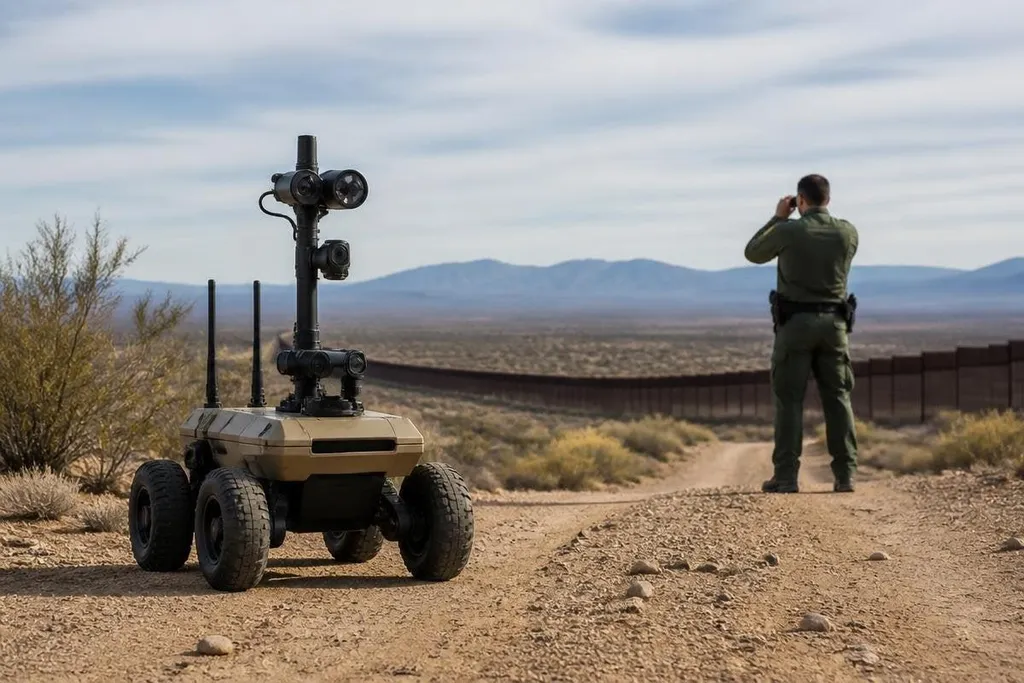
A border security robot can watch a route for hours, send video to a remote team, and inspect ground a person cannot reach safely. It still cannot decide who poses a threat, explain a lawful search, or replace trained officers.
Quick read
- Patrol robots fit dull, repeated routes
- Thermal cameras and LiDAR help in darkness and poor visibility
- Remote human control remains necessary for force, searches, and arrests
What the robots would do first
The first useful systems will handle observation. A ground robot could move along a fence, road, or service track while sending video, thermal images, and location data to an operator. Aerial robots could check a wider area, then return to a charging point or land for a battery change.
That work has a clear benefit. People can spend less time walking empty routes and more time checking an alert, speaking with travelers, or responding to a confirmed incident. The robot does the repeated watch; a person decides what the signal means.
The task also suits current robot parts. LiDAR measures distance with laser pulses, while thermal cameras show heat differences that ordinary cameras may miss at night. A global navigation satellite system can add location data, although trees, cliffs, buildings, and radio loss can reduce its value.
Sensors do not make a decision
A sensor reports a pattern. It does not explain the cause. A thermal camera may show a warm shape near a road, but that shape could be a person, an animal, an engine, or sun-heated ground.
Software can sort alerts by size, movement, location, and time. That may cut down the number of routine checks, but a false alarm still needs a person to review the video and decide what happens next. A system that sends too many alerts becomes another screen for an already busy control room.
A border patrol manager needs more than an alert count. Border security robot reporting can tie a system’s sensor range, test site, date, and operator role to the result. That record leads into identification, where a useful image still leaves a person to decide what the match means.
The same rule applies to identification. A camera may read a vehicle plate or capture a face, but matching that image to a person raises legal and privacy questions that the robot cannot settle.
The system needs clear rules for collection, storage, access, and deletion before it enters routine patrol work.
The hard limits
Terrain will decide where these machines work. Loose sand, mud, snow, steep ground, and tall grass can cut speed or drain a battery. A wheeled robot may handle a maintained service road, while a legged robot may cross rough ground but cost more to buy and maintain.
Communications create another limit. A robot that depends on a radio link may stop sending live video behind a hill or inside a valley. Local recording can preserve the event, but it cannot give an operator control during the gap.
Weather adds more work. Rain can cover lenses, heat can change battery performance, and cold can reduce available power. Any plan needs stated operating temperatures, water protection, repair time, and spare parts. A machine that sits in a depot after a small fault has little value on patrol.
I’d keep human control over every action that can injure, detain, search, or identify a person. That line also makes system testing easier because the robot has a narrow job and the operator has clear responsibility.
A buying checklist
Before a border agency orders a robot, it should:
- Define the route and task in writing, including patrol hours, ground type, and expected weather.
- Set the alert test with known examples, then record false alarms and missed events.
- Check the radio range at the actual site, not only in an open test area.
- Require a manual stop, local control, and a safe response after lost communications.
- Price batteries, sensors, tires or legs, software support, training, and repairs for the full contract term.
- Set rules for video, thermal images, facial data, access logs, and deletion before deployment.
Those checks separate a patrol tool from a remote-controlled demonstration. They also show where a cheaper fixed camera, tower sensor, or staffed vehicle may fit better.
The near-term test is simple: can a robot reduce routine patrol work without creating more alerts, repair calls, and privacy disputes than the team can handle? Until agencies publish that evidence from real border routes, the sensible role for robots is observation with a person still making the call.